








See POAS vs revenue-only reporting
Profit Bid connects store costs to ad spend so you bid on margin — not vanity ROAS.
Track POAS automatically from your store — upload profit conversions and scale winners with A/C/X labels.
Why break-even POAS is a constant
Unlike break-even ROAS, break-even POAS does not change with margin: it is always 100%, because it compares profit to spend directly.
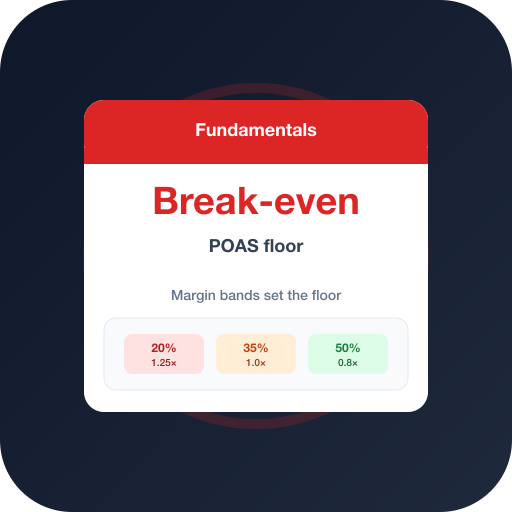
What changes is the ROAS required to reach 100% POAS. A 20% margin band needs far more revenue per ad dollar than a 50% band.
Margin bands and their ROAS floors
Segment your catalog into margin bands. For each, the break-even ROAS is 1 ÷ margin — and the profit target should sit comfortably above it.
Bidding on profit lets you enforce these bands automatically instead of managing a spreadsheet of per-category ROAS targets.
Step-by-step
Follow these in order — each step builds on the previous one.
- 1
Group SKUs by margin band
Split the catalog into low/mid/high margin buckets (e.g. 20/35/50%).
- 2
Compute each band's ROAS floor
Break-even ROAS = 1 ÷ margin for the band.
- 3
Add a profit buffer
Set the live target above break-even to cover fixed costs and profit.
Try the break-even calculator
Enter your margin band and target POAS buffer. For a dedicated URL you can bookmark and share, use /tools/break-even-roas.
Frequently asked questions
Common questions about this topic — tap to read answers.
Is break-even POAS the same for every store?
Yes — it is always 100%. What differs is the revenue efficiency (ROAS) each store needs to reach it, based on margin.
What buffer should I add above break-even?
Enough to cover fixed costs and desired profit — often a target of 120–200% POAS depending on overhead and LTV.