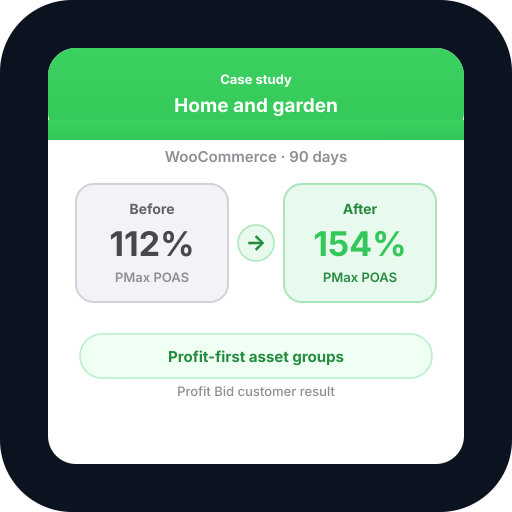
Illustrative scenario — composite example based on common ecommerce patterns, not a named customer case study.
Performance Max, rebuilt around profit
A WooCommerce home & garden store fed profit values into Performance Max, reallocating budget across asset groups by real margin instead of revenue.
A WooCommerce home & garden brand loved PMax's reach but suspected it scaled low-margin volume. Feeding profit values reshaped budget across asset groups.
Store
WooCommerce
Ads
Google Ads (PMax)
Duration
90 days
The challenge
PMax delivered strong Return on Ad Spend but blended everything together. High-margin tools and decor were lumped with low-margin bulky furniture, and the algorithm favored cheap conversions that quietly eroded profit.
Approach
Mapped per-SKU margin including freight on bulky items.
Split PMax into asset groups by margin tier.
Uploaded profit-weighted conversions to steer the algorithm.
Fed profit signals so PMax optimized contribution, not revenue.
Shifted budget toward high-margin asset groups.
Performance
Profit by PMax asset group
Profit Bid
Splitting PMax by margin tier and feeding profit values pushed budget toward the asset groups that actually earn.
Profit on Ad Spend (PMax)154%
+42 pts
High-margin spend share58%
Reallocated
Bulky low-margin spend17%
Reduced
Results
Profit on Ad Spend (PMax)
112%→154%
+42 pts
High-margin spend share
31%→58%
Reallocated
Bulky low-margin spend
40%→17%
Reduced
Gross profit/mo
€19k→€31k
Same budget
“PMax was a black box scaling our worst-margin products. Profit signals turned it into our most profitable channel.”