Home Case Studies Beauty subscription LTV ← Back to case studiesIllustrative scenario — composite example based on common ecommerce patterns, not a named customer case study.
The challenge First-order Profit on Ad Spend on prospecting sat near 95%, so the team throttled acquisition. But repeat purchase rate was strong — customers reordered serums every 6–8 weeks. Judging campaigns on the first order alone was leaving growth on the table.
Approach Connected Shopify orders, cost per item, and subscription reorders. Built cohort LTV curves by acquisition channel. Set LTV-adjusted Profit on Ad Spend targets for prospecting campaigns. Kept retention campaigns on immediate-profit targets. Monitored payback period to cap cash risk. First-order Profit on Ad Spend LTV-adjusted Profit on Ad Spend
M0 M1 M2 M3 M4 M6
First-order Profit on Ad Spend stayed flat; counting reorder profit revealed customers worth 2.4× the first sale. First-order Profit on Ad Spend 98%
Roughly flat by design LTV-adjusted Profit on Ad Spend (M6) 236%
Repeat profit counted New customers/mo 1,840
+60% acquisition Results First-order Profit on Ad Spend 95% → 98%
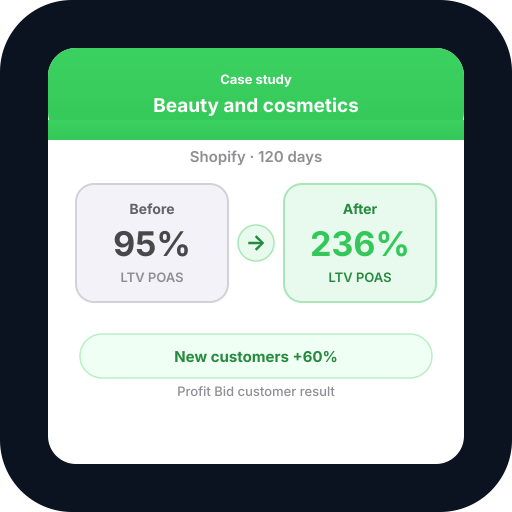
Roughly flat by design LTV-adjusted Profit on Ad Spend (M6) 95% → 236%
Repeat profit counted New customers/mo 1,150 → 1,840
+60% acquisition Payback period n/a → 41 days
Within target “We were turning off our best acquisition because the first order looked break-even. LTV-adjusted Profit on Ad Spend gave us permission to grow.”
— Sophie L., Growth lead, beauty DTC Stack Shopify Google Ads Search + PMax Profit Bid Pro
Pricing Run this playbook on your store — choose your plan Select a plan and continue to secure checkout — Profit on Ad Spend conversion upload included on every tier.
Starter
$14.99 / month
billed monthly
For one store getting started with profit-based bidding
Choose Starter Growth
$39 / month
billed monthly
For brands that need a second store — same platform or mixed
Choose Growth Pro
$79 / month
billed monthly
For multi-store teams with advanced Google Ads
Choose Pro Scale
$149 / month
billed monthly
For agencies and high-volume merchants
Choose Scale 14-day free trial available — start free · full pricing details